Most people have experienced it at least once.
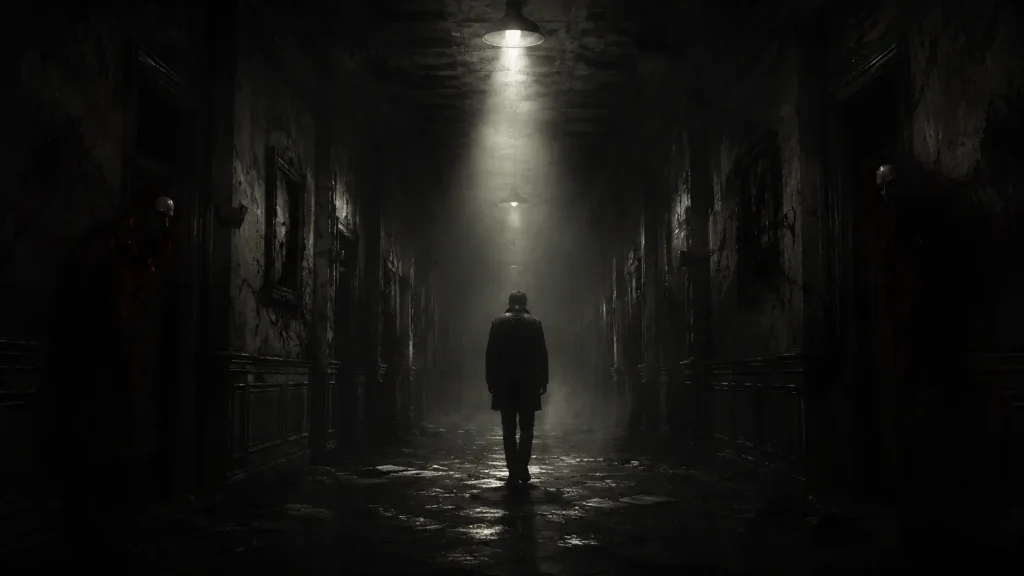
You are alone. Nothing appears out of place. The room is quiet. The street is empty. Yet something feels different. You find yourself looking over your shoulder or glancing toward a doorway for no clear reason.
You cannot explain it, but the feeling remains.
Someone is watching.
Whether that feeling is real or imagined almost does not matter. The discomfort comes from the possibility itself.
That idea sits at the heart of The Funeral Director.
Many horror stories rely on visible threats. Readers are shown the danger and are asked to fear it. In The Funeral Director, fear often works differently. It grows from uncertainty. It begins with a feeling that something is not quite right. A pause that lasts a little too long. A glance toward an empty space. The sense that an ordinary moment has somehow changed.
Those small moments often create more tension than obvious threats.
Part of what makes being watched so unsettling is that it changes the way people behave. The moment we think someone is observing us, we become aware of ourselves. We notice things we would normally ignore. We question our surroundings. We pay attention to details that never seemed important before.
The world remains the same, but it no longer feels the same.
That shift is something The Funeral Director captures remarkably well.
Throughout the novel, people begin noticing things they cannot fully explain. They become aware of movements, sounds, and moments that leave them questioning what they saw. Their certainty begins to fade. Familiar places no longer feel familiar. Everyday routines become uncomfortable.
The fear does not arrive all at once.
It builds gradually.
That gradual approach is one reason psychological horror can be so effective. A sudden shock may startle readers for a moment, but uncertainty can stay with them for much longer. Questions have a way of lingering. The human mind naturally searches for answers, and when those answers never fully arrive, the imagination often fills the gaps.
That is where some of the strongest fear comes from.
The novel understands that people are often more disturbed by what they suspect than by what they know. A closed door can be more frightening than an open one. A shadow can feel more threatening than a clear image. A feeling can stay with us longer than a fact.
Because of that, The Funeral Director creates tension without needing to explain everything immediately. Readers are invited to experience the same uncertainty that affects the characters. They are asked to notice small changes, question familiar surroundings, and wonder whether the things happening around them can be trusted.
The result is a story that stays beneath the surface long after the final chapter.
At its core, The Funeral Director is not simply about fear. It is about awareness. It explores what happens when people begin paying attention to things they once ignored and what happens when ordinary life no longer feels entirely safe.
That idea is difficult to shake because it touches something deeply human.
Most of us are not afraid of what we can clearly see.
We are afraid of what might be standing just beyond our view.